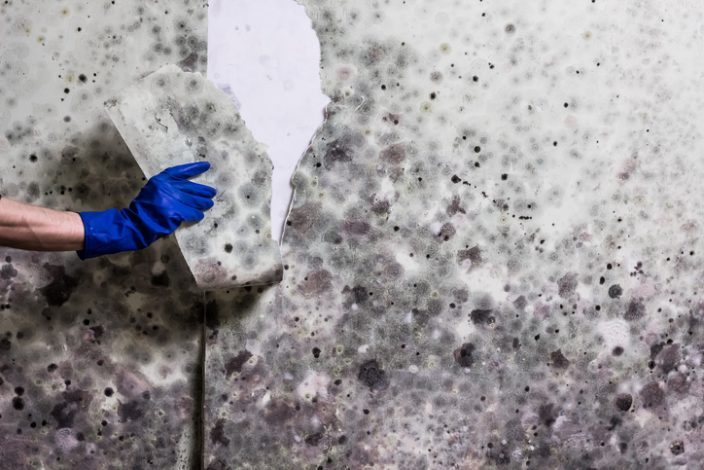
The root word is “remedy,” and when we get involved in a mold remediation project, we are puroclean damage restoration attempting to remedy the house or building of the potentially dangerous effects of mold growth. This can be as simple as controlling the humidity of a room or as complex as a partial tear-down and replace.
Most of the time, only certain areas of the house or building are affected. It is important for MVP to identify the problem areas, remove the elements that are affected and dispose of them in a safe and proper manner. Hopefully, we can solve the problem without having to do major work, but if needed, our experts use the utmost care and caution, adhering to strict industry standards, when demolition and removal are required.
Once the affected areas have been removed, MVP does a rough clean in the contaminated area and a thorough (micro) clean on any portions of the structure necessary once the contained area has been removed.
Finally, we do post-remediation testing to make sure the environment is free of mold and that it is safe to return for your family members or building occupants. It is our primary goal to “remedy” the problem so that you can get back to your life quickly and with peace of mind.
Water Damage Restoration Company
In cases where mold contamination is suspected, the first order of business is to track down the moisture sources that are creating the conditions favorable to its amplification.
PHASE I: THE INITIAL SURVEY
PHASE II: REMEDIATION
Depending on the situation, below is a list of things that we look for in our preliminary investigation:
Gather information and fact finding before the on-site visit to obtain information on the building, its systems, occupants, activities, complaints and illnesses (if any).
An investigation of general environmental conditions which could influence the Indoor Air Quality (IAQ) in the areas of suspicion. An inspection of the HVAC systems supplying these areas as well as an overall inspection of other areas that may be of concern.
Documentation, both written and photographic, is the next important step.
Testing for general indoor parameters such as temperature, relative humidity, dew point and possibly carbon dioxide, carbon monoxide and other volatile organic compounds may be done at this time.
Air-O-Cell samples may be collected in order to determine the levels of airborne particles such as mold/fungal microorganisms and spores, opaque particles, skin cell fragments, dust and fibers.
If testing is needed, air samples will be collected from the area of concern, but also from non-compliant areas and the outdoors for comparison purposes.
Preparation of a written report of our findings and recommendations for corrective actions where problems have been identified.
 Site Title
Leave a comment